


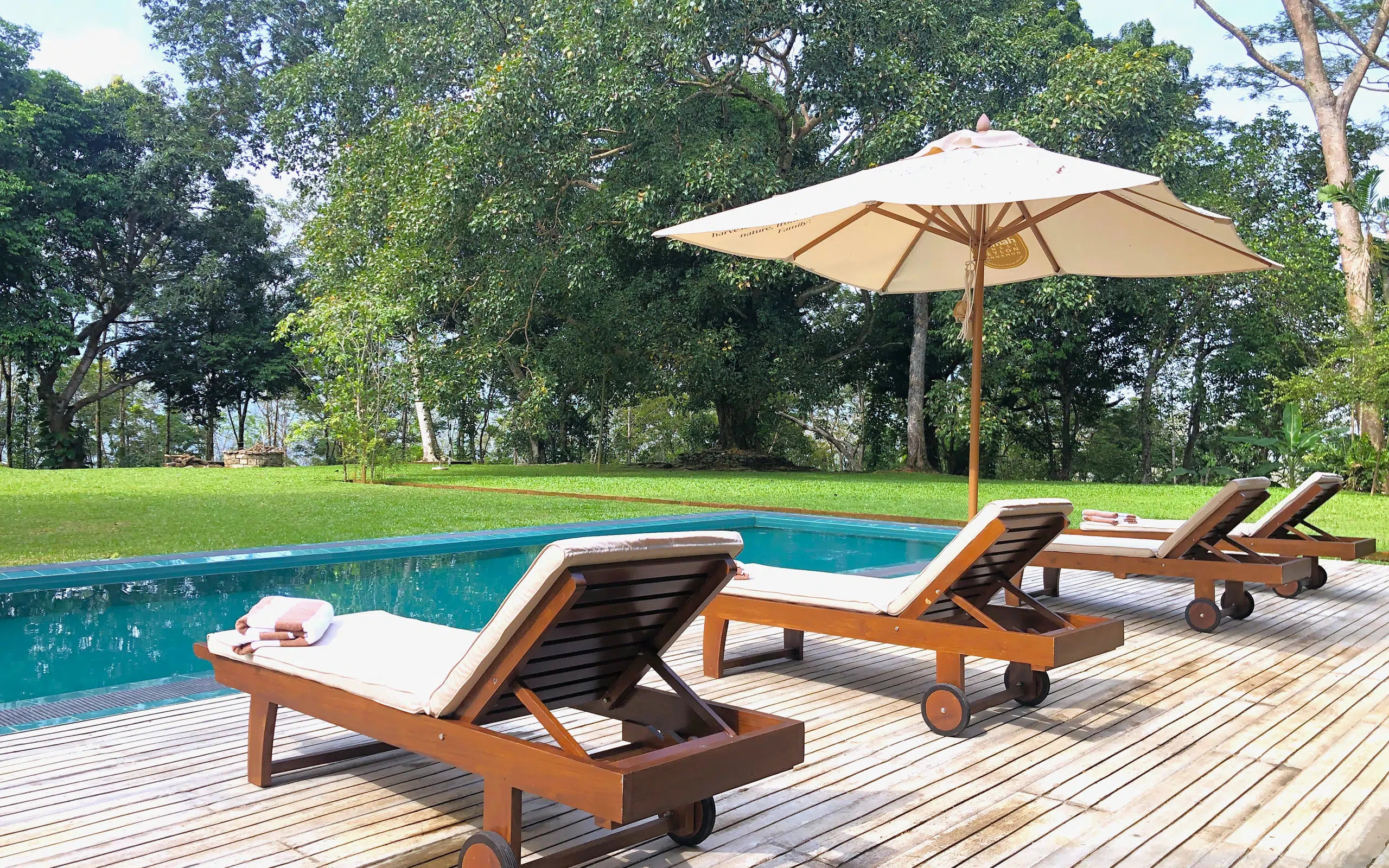
Some places in Sri Lanka you visit for a single attraction. Denawaka Planter’s Bungalow isn’t one of them — it’s a place you go to slow down completely. Perched on a hilltop within the Rilhena Estate near Pelmadulla, in the gem-rich Ratnapura District of Sabaragamuwa Province, this restored colonial-era planter’s residence sits above the clouds with the misty hills of the Denawaka valley rolling out in every direction. There’s a swimming pool, a working cinnamon experience centre on the estate, cycling trails through the plantation, and a silence broken mostly by birdsong.
This guide covers everything you need to plan a stay: what Denawaka Planter’s Bungalow actually is, how to get there, what a day looks like, the food, the weather, and the wider Ratnapura–Sinharaja region it opens up.
Quick facts
| Denawaka Planter’s Bungalow | Get to know about Denawaka Planter’s Bungalow |
|---|---|
| Type | Heritage tea planter’s bungalow, private whole-house rental |
| Operator | Kahawatte Plantations PLC |
| Location | Rilhena Estate, near Pelmadulla, Ratnapura District, Sabaragamuwa Province |
| Distance from Colombo | ~110 km (approx. 3–3.5 hrs by road) |
| Bedrooms | 4 (up to ~10 guests) |
| Key features | Swimming pool, cycling trails, bird watching, Ceylon Cinnamon Experience Centre |
| Nearby attractions | Sinharaja Rainforest, Adam’s Peak, Ratnapura town, Udawalawe National Park |
| Best months | January–April |
| How to book | MyTickets Holidays, direct via Kahawatte Plantations, or international listing sites |
What is a planter’s bungalow?
Before Denawaka itself — if you’re new to the category, a planter’s bungalow is a residence built during Sri Lanka’s British colonial tea era as the private home of an estate superintendent, or “planter.” They’re typically found on working tea, rubber, or cinnamon estates, built with thick walls, deep shaded verandahs, and generous gardens designed for a slower, plantation-paced life. Today, a growing number have been restored as private holiday rentals across the hill country and lowland estate regions — offering travellers a genuinely different experience from a standard hotel: you stay inside a working plantation rather than beside one. Denawaka is one of these, and one of relatively few located in the lowland Sabaragamuwa estate belt rather than the more commonly visited Nuwara Eliya or Kandy hill country.
What is Denawaka Planter’s Bungalow?
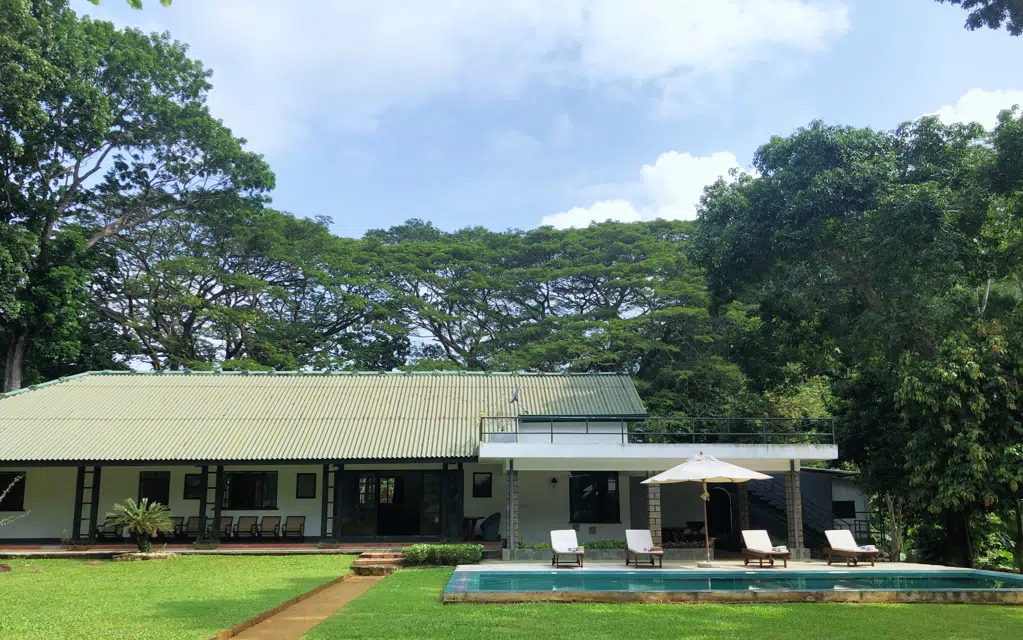
Denawaka Planter’s Bungalow is a heritage plantation bungalow operated by Kahawatte Plantations PLC, one of Sri Lanka’s established tea, rubber, and cinnamon producers, whose holdings stretch from the mid-country hills above Kandy down into the fertile, gem-laden lowlands of Sabaragamuwa. The bungalow sits within the Rilhena Estate, one of the company’s working plantations, which is part of what makes a stay here different from a standard hotel: you’re a guest inside a functioning tea and cinnamon estate, not on the edge of one.
The property has four bedrooms, comfortably hosting up to around ten guests, which makes it suited to a family gathering, a small group of friends, or a couple wanting an entire private house rather than a hotel room. Planter’s bungalows like this one were originally built during the British colonial tea era as the private residences of estate superintendents — thick walls, deep verandahs, and large gardens designed for a slower, plantation-paced life. Denawaka carries that heritage while being run today as a private holiday rental.
Location: where exactly is it?
The bungalow is located above Pelmadulla, a town in the Ratnapura District roughly 110 km southeast of Colombo and about 20 km from Ratnapura itself. The wider area — carved by the Denawaka and Way rivers between the Kuttapitiya and Kiribathgala hill ranges — is known locally for tea, rubber, and gem mining, and for a scatter of waterfalls (Kirindi Ella, Pulun Ella, Rajana Ella) within easy reach.
Strategically, this puts Denawaka Planter’s Bungalow in one of the most underrated base locations in Sri Lanka: close enough to the Sinharaja Rainforest for a proper day trip, within range of Adam’s Peak (Ratnapura is the classic southern approach), and a reasonable drive from Udawalawe National Park for a safari extension — three major experiences from one hilltop base, without the crowds of Ella or Kandy.
How to get to Denawaka Planter’s Bungalow
By train: important correction — the Kelani Valley railway line, which historically extended up to Opanayake, has been limited to Avissawella since the narrow-gauge-to-wide-gauge conversion decades ago. There is currently no train service to Pelmadulla or onward toward Denawaka. If you’d like to include rail as part of the journey, the practical option is to take the train to Avissawella and arrange a taxi or pre-booked transfer for the remaining road distance — otherwise, road transport for the full journey is simpler.
By road from Colombo: the most straightforward route follows the A4 highway toward Ratnapura, then on toward Pelmadulla. [VERIFY: exact driving time from Colombo — estimate roughly 3–3.5 hours depending on traffic through the outskirts]. A private car or pre-arranged transfer is the easiest option, since the final approach climbs estate roads that are more comfortable in a proper vehicle.
By bus: regular Colombo–Ratnapura–Pelmadulla buses run the A4 corridor; from Pelmadulla town, a tuk-tuk covers the final approach.
Arrival tip: because the bungalow sits on estate land, the practical approach is always to confirm your arrival time directly with the bungalow team — General line: +94 77 976 8789 · Email: [email protected] — so staff can guide you (or a driver) up the final unmarked stretch. This isn’t a drive-up-and-check-in hotel; a little coordination makes the arrival smooth rather than a hunt for a gate.
Special Promo Code: MYTHYA2026 and get 10% off
Rooms and what to expect from a stay
- Four bedrooms, suited to families or groups of up to roughly ten guests — one of the few properties in the region offering the whole house rather than individual rooms, which means genuine privacy for a group.
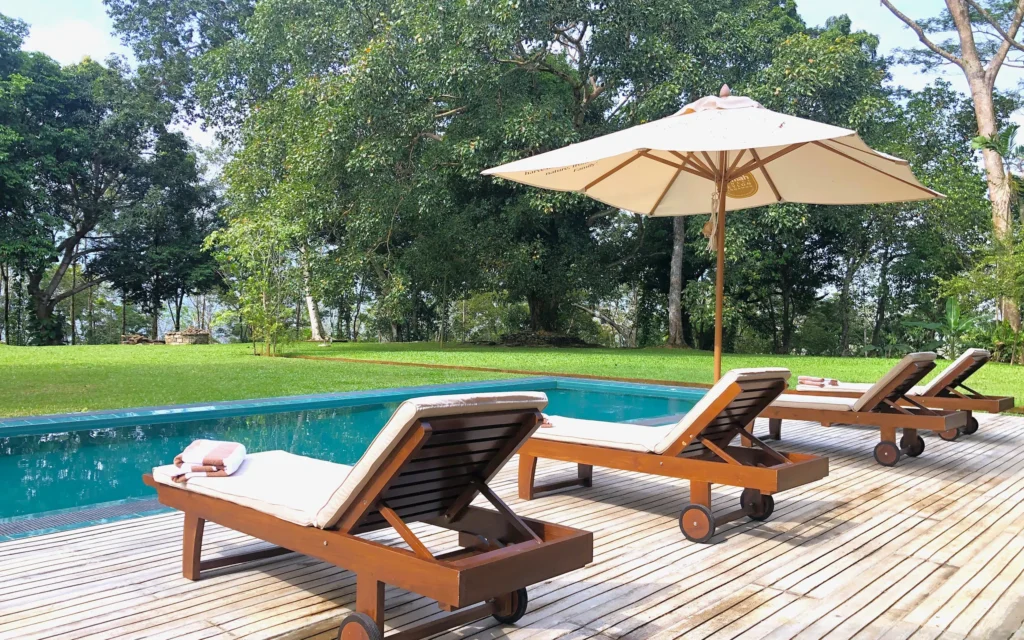
- A swimming pool with hill-country views — a rare feature at this elevation and one of the property’s signature draws for families travelling with children.
- Verandahs and gardens built in the original planter’s-bungalow style: deep shaded porches designed for sitting out through the misty mornings and warm afternoons.
Because the whole bungalow is typically booked as one unit, it suits multi-generational family trips particularly well — grandparents on the verandah, children in the pool, everyone together for meals, without the compromises of a shared hotel.

Estate stay activities near Sinharaja: things to do at and around Denawaka
On the estate itself:
- Cycling trails through the plantation — a genuinely rare way to experience a working tea and rubber estate, at your own pace, past workers’ lines and tea-pluckers going about an ordinary working day.
- Bird watching — the estate’s mix of cultivated land and forest edge draws a good range of hill-country and lowland species; bring binoculars if you have them.
- The Ceylon Cinnamon Experience Centre, a feature unique to this property among Sri Lanka’s plantation bungalows — a hands-on introduction to how true Ceylon cinnamon (different from the cassia sold as “cinnamon” in most of the world) is grown, peeled, and processed, run by people who do this for a living rather than for tourists.
- The pool and gardens for simply doing nothing, which, on an estate this quiet, is not a small thing.
Day trips from the bungalow:
- Sinharaja Rainforest — Sri Lanka’s premier lowland rainforest and a UNESCO World Heritage Site, reachable as a day excursion from the Ratnapura side entrances. See our full Sinharaja guide for what to expect and how the guide system works.
- Ratnapura town — the “City of Gems,” worth a half-day for the gem markets and museums if you’re curious about Sri Lanka’s gem-mining heritage, one of the country’s oldest industries.
- Adam’s Peak (Sri Pada) — Ratnapura is the traditional southern base for the pilgrimage climb; in season (roughly December–May) this makes a genuinely feasible add-on for guests willing to attempt the night climb.
- Local waterfalls — Kirindi Ella and others dot the Pelmadulla area, most reachable as a short drive plus a walk.
- Udawalawe National Park, for elephant safaris, sits within striking distance for guests wanting to extend into the dry-zone wildlife circuit.
Food and cooking at Denawaka
Plantation bungalow stays in Sri Lanka traditionally include home-style cooking prepared on site — rice and curry built around estate and local produce, fresh vegetables, and the kind of unhurried, generous hospitality associated with tea-country bungalow culture.
Given the Ceylon Cinnamon Experience Centre on site, expect cinnamon to make a genuine appearance in the kitchen here in a way it rarely does elsewhere — this is a property that can honestly claim the spice is grown steps from where it’s cooked.
Weather and when to visit
The Denawaka valley sits in Sri Lanka’s wet zone, in the foothills between the coastal lowlands and the central highlands — expect a cooler, mistier climate than the coast, with genuine rainfall through the southwest monsoon months (roughly May–September). The relatively drier window for this region tends to fall between January and April, overlapping conveniently with the best conditions for both Sinharaja and Adam’s Peak season. Check current outlooks via the Department of Meteorology before travelling, since hill-country and wet-zone weather shifts quickly and locally.
Whatever the season, mornings here are the payoff: mist sitting in the valley below the hilltop, burning off through the late morning — a view worth setting an alarm for.
Booking Denawaka Planter’s Bungalow
For travellers based in Sri Lanka, or anyone who’d rather book locally than through an international intermediary, MyTickets Holidays lists Denawaka Planter’s Bungalow alongside other Sri Lankan holiday properties — a straightforward option if you’re already planning other parts of your trip (events, dining, transport) through one local platform, with support and payment handled in-country rather than through an overseas booking site.
You can also book:
- Directly with the property — General line +94 77 976 8789 or [email protected], via Kahawatte Plantations
- Through the international listing sites the property also maintains a presence on, if that’s your preferred payment method or currency
What to confirm before booking, regardless of channel: exact guest capacity for your group, meal inclusions, pool access and any seasonal maintenance closures, and the arrival coordination described above — since the final approach isn’t a standard hotel drive-up.
Is Denawaka Planter’s Bungalow right for your trip?
This property rewards travellers who want one full day, minimum, of doing nothing built into their itinerary — not a one-night stopover between bigger attractions. It suits:
- Families wanting a private house with a pool rather than shared hotel spaces
- Couples after a genuinely quiet, private retreat away from the south-coast and hill-country tourist circuits
- Anyone building a Sinharaja + Adam’s Peak + Ratnapura loop, since the bungalow sits conveniently at the centre of that triangle
- Travellers curious about plantation life — the cycling trails and cinnamon centre offer access to a working estate that few properties in Sri Lanka can genuinely provide
It’s less suited to travellers wanting nightlife, restaurants within walking distance, or a short one-night stay — the value here is in slowing down, which needs at least two nights to feel worth the journey up the hill.
FAQ
How many guests can Denawaka Planter’s Bungalow accommodate? Four bedrooms, comfortably suited to groups of up to around ten.
Is it suitable for children? Yes — the pool and grounds are genuinely child-friendly, though as with any hillside property, supervise younger children around the pool and estate edges.
Do I need a car to get there? Strongly recommended, or a pre-arranged transfer/taxi — there’s no train service to the immediate area, and the final approach is estate road rather than a mapped public route.
Can I combine this with Sinharaja in one trip? Yes — this is one of the most convenient bases for a Sinharaja visit in the country. Plan a full day for the rainforest itself.
What’s the best time of year to visit? Roughly January to April for the driest window, though the hilltop setting is atmospheric — arguably more so — even with mist and light rain.
Is cinnamon farming really part of the experience? Yes — the estate’s Ceylon Cinnamon Experience Centre is a genuine, working part of Kahawatte Plantations’ production, not a tourist replica.
Continue planning the Ratnapura region: our guides to Sinharaja Rainforest and the hiking in Sri Lanka ranking. Denawaka Planter’s Bungalow can be viewed and booked via Kahawatte Plantations or MyTickets Holidays.
Last updated July 2026. Rates, meal plans, and availability change seasonally — always confirm current details directly before booking.